Archive
The Grinder vs The Showboat in RPGs
Here’s a question that comes up from time to time when I’m playing role-playing games. Is it better for your character to have a mechanical advantage on its character sheet or to have a non-mechanical advantage gained through role-playing with NPCs and interacting with the plot?
I realize that with a question of that level of complexity the immediate reaction is probably, “Wha… huh?” So, let’s break this down and analyze it a bit. There are a couple of types of gamers that personify the extreme end of each option: the Grinder and the Showboat.
1: The Grinder
In the lingo of MMORPG players, a “grinder” is someone who goes out and kills things repeatedly just to get the experience necessary to level up. This term has mutated a little and drifted over to tabletop, where it refers to a player who’s only interested in gaining more and more of a mechanical and tactical advantage – and often does so by focusing solely on the hack and slash elements of the game.
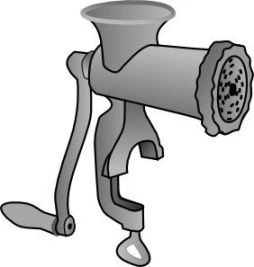 Grinders can be fun to play with if you’re not taking the game too seriously. Unfortunately, they can also kill the role playing element by encouraging the rest of the group to focus solely on the game’s tactical or mechanical aspects. Now, some groups are fine with this. If you have a group full of Grinders, then there isn’t really a problem.
If the group is a bit more diverse, however, then having one or more Grinders can become more of an issue. If they just keep going on unchecked without considering the rest of the group, they can hog attention and make the game less fun for everyone else. Similarly, if the GM or other players crack down too hard on the Grinders in a group, then that means less fun for the Grinders, which isn’t good either.
So when I feel like grinding as a player I try to keep it reined in enough that it won’t stomp all over other players’ fun. When I’m running a game with a Grinder in it, I try to make sure that there’s enough action to satisfy him or her without it getting too ridiculous for the other players.
2: The Showboat
The term “showboat,” while originally referring to a paddle-wheel steam ship used as a traveling theatre, has also come to mean a person who likes to show off for the sake of attention. I’m sure anyone who’s played a lot of RPGs has run into their fair share of individuals who like to role-play their characters and are very good at talking. That’s all well and good and even encouraged in most games, but when they overdo it to the point that they’re showboating, it can become a problem. I will admit that as a former theatre student, this is a trap I’m a bit more prone to fall into.
 Like Grinders, Showboats can draw a lot of attention away from other players if they don’t watch themselves. Some will deliberately play their characters to the hilt with the express purpose of hijacking the game’s narrative. That means they can end up taking control of the plot to make their characters more important or to gain advantages that aren’t mechanical but effectively exempt a character from game mechanics the other players still have to deal with.
When I feel like I’m starting to show off too much I try to take it down a notch. These kinds of players can be tough to keep in line, but the important thing for a GM to remember is to keep paying attention to the other players as well as the Showboat.
Whether you’re dealing with mechanical rewards or story rewards, the key is moderation.
As a GM, I think it’s important to have a good balance of rewards in a game. Offering both mechanical and story rewards will encourage players to go for both. Keeping an eye on what aspects of the game each player enjoys and scaling the different elements of the game accordingly will go a long way towards keeping the players happy.
As a player, I think that having mechanical advantages on your character sheet is very helpful – after all, it’s much cooler when your character’s effective – but those advantages always need to line up with the concept you have for the character. That includes how you’re going to role-play him or her. Similarly, gaining power, influence or other story-based perks through role-playing is great, but not to the extent that you completely undermine the game’s mechanics.
So which kind of advantage is better? Neither. Or both. It really depends on your playing style, but in my opinion if you try to set a balance between the two, you’ll get a lot more out of the experience – without having to grind OR showboat.
Click below if you’d like to hear me read the article:
DOWNLOAD
Music by www.pacdv.com/sounds/
Kicking the Tires on 4th Edition D&D
The amount of vitriol being spewed all over the place over the most recent edition wars going on with Dungeons & Dragons – even more than a year after 4th Edition’s premier – is mind-boggling, but I try not to let it affect me.
I’ve heard a lot of people say, “4th Edition ISN’T Dungeons & Dragons!” I kind of find this analogous to saying “The current Volkswagen Beetle ISN’T a Volkswagen Beetle!” But what exactly does it mean? My basic assumption is that they’re saying the new version doesn’t do the same things that the old version did, and because of that the two versions are completely different products.
That part sounds reasonab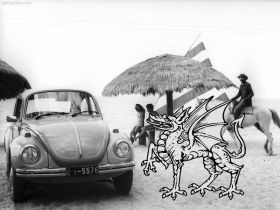 le, but there’s more to it than that. When someone makes a statement that bold they usually have an emotional attachment to the subject matter. What they’re really telling us is that they will never accept the new product in their heart of hearts as being the One True D&D (or the One True Beetle). Of course the problem with that is that it calls for an absolute definition of truth – which is NOT something I’m going to get into right now, so let’s just stick to the basics, shall we?
When the new Volkswagen Beetle came out, they pretty much changed everything that I’d liked about the original Beetle. Notably, the engine was now up front, which not only changed the way the car handled, but took away most of the storage space. To me, the whole POINT of the Beetle was that it was a tiny car that you could cram a LOT into. I didn’t want to accept that the new car was also called the Beetle. But, that said, I’ve ridden in one of the new Beetles and it’s pretty much like being in any other small car being made these days. Not brilliant, but acceptable.
I played the 1st and 2nd editions of D&D growing up and had a good time with them. I really liked 3rd Edition when it came out and continued to enjoy playing it right up until the release of 4th Edition. Around the time 4E was being released I began to hear rumors about it being just like MMORPGs, which worried me a little – after all, if I want to play World of Warcraft, I just go to my computer. Why try to recreate that in a tabletop game?
Then I played 4th Edition and it turned out I enjoyed it. I’ve been playing in a 4th Edition campaign for a few months now and am having a great time. Even though, as advertised, it IS a lot more like an MMO.
Not absolutely everything is different. For example, I think some folks might lose sight of the fact that there were ALWAYS party roles in D&D, even back in 1st edition. You had to have a magic-user type to take out enemies from a distance. You had to have a fighter type to generally kick butt, take names and act as a meat shield for the magic-user. You had to have a thief type to disarm traps, open doors and get at those targets the fighter just couldn’t get to alone. And, of course, you had to have a cleric to keep everyone on their feet.
Sure, the specifics of how each class worked would shift around from edition to edition, but the idea of party roles was always there. 4th Edition just took a page from the MMO playbook and formalized those roles. Sure, it makes it a little more like a computer game, but it’s still fun to play and – this is the important part – it doesn’t discount the human element.
It DOES treat the human element a bit differently from the way previous editions did, and I’ll probably talk more about that in another article. It also behaves much more like a tactical skirmish game than previous editions. But does that mean it isn’t “really” D&D?
Let’s be honest, here. The meanings of names – and words in general, for that matter – change from generation to generation. What we say isn’t “really” a VW Beetle now will probably be called a VW Beetle by our grandkids whether we like it or not, and who knows what THEIR grandkids will call it? You can try to fight it – good luck with that, by the way – or you can accept it.
I look at it this way. There are these two different models of cars. They’re both called the VW Beetle. I also accept the fact that there are four different games out there each called Dungeons & Dragons. It’s kind of like understanding that there are millions of guys out there who are all named Jim. Unless I snap one day and decide that There Can Be Only One, I expect that state of affairs to continue for the foreseeable future.
I’ve by no means abandoned earlier editions. They still hold a special meaning for me, and I hold out hope for the coming of that day when I can drive off in my original Beetle to the Gamer Retirement Community and play original D&D with the rest of the Old Guard until the end of time. I’m just saying that while there will always be a place for those originals in my heart, I’m glad I still have enough room in my head for new ideas.
Click below if you’d like to hear me read the article:
DOWNLOAD
Running Around Pretending to be Vampires
“There’s a large group of people in the park all wearing black. They must be dangerous!”
No, we’re not. We’re just playing a game.
Thankfully, the stigma associated with live-action role playing looks to have diminished a bit over the years. I play in a Vampire: the Requiem LARP with about thirty to fifty people every other weekend and I can tell as new people keep coming in that our player base is becoming much more diverse. Which is a really good thing.
But not everyone has decided to embrace live-action gaming. Even a lot of tabletop RPG players are still on the fence about it. If you’re thinking about experimenting with live-action, here are a few things I can tell you right off the bat to try to make sure you’re not going in with the wrong impression.
First off, a lot of people see LARPers dressing in strange costumes and wandering around in semi-public areas and think they’re a bit nuts. Having interacted with LARPers regularly, I can confirm that they’re no crazier than the average tabletop role player. While I realize that sounds like a setup for a joke – one that I’m trying heartily to resist as I write this – what it really means is that in live-action you get a range of people, just like you do with any hobby. Some are going to be stranger than others. Some will be perfectly normal folks you could easily see hanging out with on a Friday night. Others will be a bit odd and socially awkward, but basically all right once you get to know them. A few others will act like they’re going for the title of Bull-Moose Bozo of the Psycho Ward, and you can generally spot those types pretty quickly and do what most of the rest of us who LARP do – avoid them!
One little caveat, though: if you do run into someone acting strangely there’s a chance they might be role-playing. If you’re not sure, the best way to find out is to just ask someone nearby.
“Hey, is he for real or is he role playing?”
That’s all it takes, honestly. Anyone who’s there to have a good time and behaves like a civil human being should be happy to tell you what’s going on.
That leads me to my next point. If you’re used to tabletop games, there are a few little differences you’ll notice aside from the fact that you’re up and walking around now instead of at a table. One of those differences is that there’s generally more of a focus on role playing and less of one on game mechanics. The mechanics do tend to come into play a little more often in “boffer” style LARPs – in which you strike people with soft, foam weapons – than in “salon” style LARPs – in which there’s generally little or no physical contact – but overall there’s still less of an emphasis on game mechanics in live-action than in tabletop games.
LARPs will usually have more players than a tabletop game, and while the Game Master or Storyteller will be doing things all the while to let the players interact with a plot line that may be running in the background, the main focus of the game is going to be your interaction with the other players. You might want to think of going to a LARP as being like going to a party, hanging out and socializing as a character you’ve created. Instead of waiting to follow a pre-determined plot, you and your friends are creating your own stories and intertwining those stories with the GM’s plots when the opportunity presents itself. In quite a few live-action games, you get to decide when and if you involve yourself in the game’s various storylines.
So, if you’re thinking about getting into a LARP, go ahead and give it a try. You don’t have to have any special skills for it. Costumes are usually optional; in those rare cases when they’re not, they’ll probably have something you can throw on so you can join in. Most of the LARPers I know also play tabletop games so chances are you’d see the same kinds of folks at a LARP as you’d see at the gaming table.
Whether the interest is in tabletop, live-action or something else, when it comes down to it, we’re all gamers. Some of us just like to get up and walk around every now and then.
Click below if you’d like to hear me read the article:
DOWNLOAD
Music by www.SoundJay.com
Syndication


Jim Ryan

This is what Jim looks like uncomfortably close up.
Jim's Podcasts
 http://www.crucibleofrealms.com/
 http://www.rpgdebate.com/
 https://cyphercast.wordpress.com/
Jim's Writing for Sale!
 Abduction Etiquette
 Farrago on Amazon Kindle
- Farrago on Smashwords
 From the Dark Side on Amazon
- From the Dark Side on Smashwords
- In the Bloodstream: An Anthology of Dark Fantasy and Horror
- Kaiser's Gate: Tales from the Front on Amazon Kindle
- Kaiser's Gate: Tales from the Front on DriveThruRPG
 Main Street Rag – Spring 2010
 Titanic Jocularity!
License

Jim - Yes, THAT Jim by Byron James Ryan is licensed under a Creative Commons Attribution-Noncommercial-No Derivative Works 3.0 United States License.
 Jim - Yes, THAT Jim